• The Learning Never Stops
  • Information
    • Subjects
    • Year Plan
    • Evaluation
  • Assessment
    • Criteria Sheets
    • Behaviour Criteria C-Charts
  • Gallery
    • Photos
    • Sports
    • Animations
    • Videos
WELCOME TO MR FISHER'S CLASS

States of matter

5/21/2019

 
Picture
It was a great day of learning after 4 days off.  We got right back at it with Social studies to start the day.  We went over critera for the Socials project and let the groups start collaborating.  After recess the Algebra tests were returned and the rest of the block was used to work on their Transformation Art.  The afternoon started with Novel Approach book club meetings to share their learning, and ended with a Science lesson on the States of Matter.
***RETURN YOUR FIELD TRIP FORMS***

1) GRATITUDE JOURNAL
  • ​post some daily gratitude
2) FIELD TRIP FORMS:
  • Thursday May 23rd (Granville Island)
  • Monday May 27th (BC Place)
  • Load those compass cards

3) HOMEWORK:
  • Science Worksheet
  • Read for Novel Book Clubs
  • Keep inquiring for Socials
  • French (a few of you still need to hand in your maps and assessments)

4) POST A RESPONSE
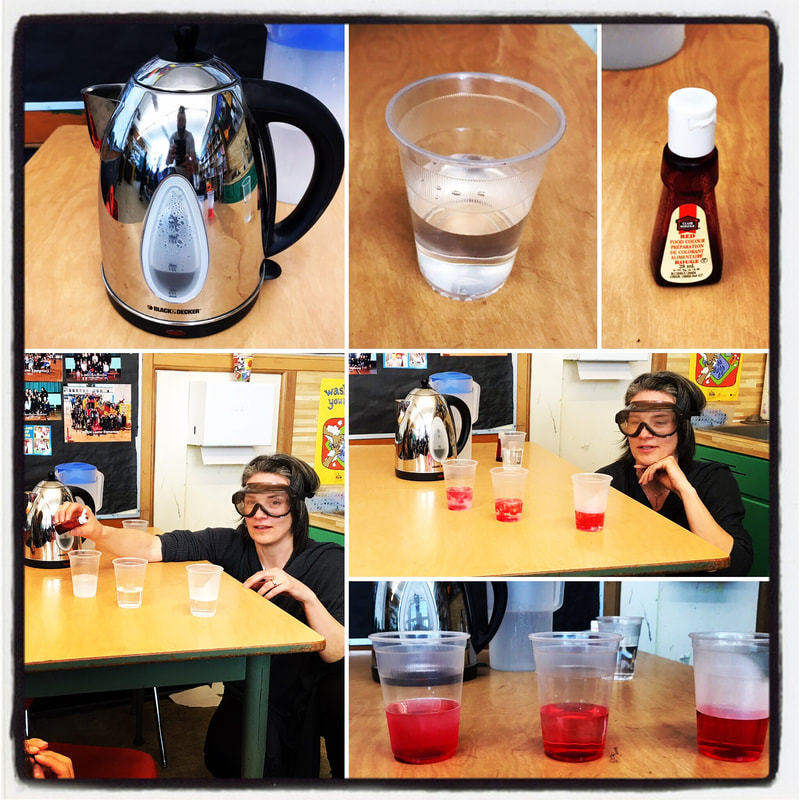
  • Today in Science we talked about States of Matter and what the atoms might look like when elements and compounds are in their various states
  • We also did a mini lab to see if we could support this idea by asking "How does temperature affect the rate at which a solute dissolves in a solvent?
  • We used varrious temperatures of water as our solvent and red food colouring as our solute.
  • In your own words write a short paragraph to explain what happened in the experiment, and how that might relate to the movement of atoms in varrious states.  

Vincent Qi
5/21/2019 06:07:57 pm

FIRST

Mountain
5/21/2019 06:11:53 pm

We learned that in the 3 different states of matter atoms move differently. Solid being fixed, liquid being loose and slowly moving around, and last of all gas being spread out and moving like crazy.
In the experiment Ms. Chohan had 3 cups of water which different temperatures. She added food colouring to each of them and wanted to see which one dissolved first.
Our hypothesis was correct, hot water dissolved the food colouring the quickest. It’s because with the slower moving atoms in colder water it make it slower to dissolve the food colouring.

Vincent Qi
5/21/2019 06:14:41 pm

@ Ms. Chohan, You made a slight mistake when saying that the atoms are moving around. However, it is actually the molecules that move as the atoms cannot separate due to the ionic force.

Nathan
5/21/2019 06:22:27 pm

3rd

Joseph
5/21/2019 06:49:46 pm

Adding to this, "various" is spelled as "varrious", in the Post a Response section, last bullet point.

@Vincent I would like to politely disagree with this statement; as indeed in a solid state of matter the atoms are basically bonded together and just vibrate, but in other states the atoms, for instance in a gaseous state, are free to move around. If you could provide a further source to back this up I'd be happy to read it :)

Vincent Qi
5/21/2019 06:58:26 pm

I understand your meaning; however, I am referring to a different situation. Atoms cannot move. They are position with the ionic force. A molecule is formed of atoms, which then they can move. However, it is less confusing to use molecules instead of atoms in such a way.

Ms.Chohan
5/21/2019 07:06:28 pm

@Vincent thank you for the correction. Yes water being a molecule not an element means the individual atoms are not moving faster, but the molecules are.

Matthew
5/21/2019 06:28:00 pm

4

Sarah
5/21/2019 06:29:46 pm

Today in science we did an experiment with hot, cold and room tempter water. We room the cups with water and put food colouring in the water. The hot water mixed with the food colouring quickest, the cold took the longest and the room tempter was in the middle.The reason was because of how the atoms react to hot and cold.

Hailey Im
5/21/2019 07:20:48 pm

Hello fellow human. I just want to clarify that we have to explain about how that might relate to the movement of atoms in various states.

Ester
5/21/2019 06:36:54 pm

In our mini lab experiment we tested whether specific temperatures change the process in which a solute dissolves in a solvent. We later found out that the food colouring (solute) dissolved faster in the hot water than in the cold water. I think this happened because imagine if the different temperature of waters represent a kind of matter. Cold would be solid because its closer to its solid form which is ice. Room temp. would be like liquid as it is because its in the middle ground like how water is in the middle ground of the different movements of molecules. Hot water would be gas as hot water is so much more in a melting state. That state in which there is the most movement of molecules is like gas. The food colouring dissolved faster in the hot water because it has more room for the molecules of the colouring to flow in. Since we represent hot like gas, gas's molecules move around more spaciously that means the hot water;'s molecules is more spaciously arranged. Now, that's the opposite of what the cold water does. Since we represent cold as solid, solid's molecules is more close together; less space in between molecules. So, cold waters' molecules have less space for the molecules of the colouring to flow in leading the colouring to dissolve slower.

-Slightly bad explaining, but I tried. :)

Ester
5/21/2019 06:38:58 pm

@Ms.Chohan how many "Gift of words" and "Thinking and learning questions" do we need to do for our NA? I already did the usual: Three gift of words and two thinking and learning questions. I just don't know if it's different now that it is novels not picture books.

Ester
5/21/2019 06:45:49 pm

@Ms.Chohan also our artist statement for our art, is it the same criteria like the one Mr. Fisher gave us? I just did it with that criteria, but just to make sure it's not something else.

Ms Chohan
5/21/2019 07:18:56 pm

@Ester, yes, 3 and 2 so choose wisely.
Yes, Artist statement criteria is like Mr. Fisher’s plus the coordinates for your 3 transfigurations

Hailey Im
5/21/2019 06:36:56 pm

Today we learned about three states of matter: solid liquid and gas. We also talked about how the atoms form when it is in a solid, liquid or gas. When it is a solid, the atoms tighten to make a solid, when it is a liquid, it is a little loose and moving around. When it´s a gas, it spreads out and moves everywhere. We also had an experiment where Ms. Chohan poured different temperatures of water and put them in 3 different cups: frozen water, room temperature water, and boiling hot water. She then proceeds to put food colouring in each of the cups, to see that if the temperature affects how a solute dissolves into a solvent. It turns out that the food coloring in the frozen cup didnt dissolve as fast as the boiled one, whereas the room temperature one was in between. In conclusion, the hot water with food colouring was dissolved quicker because the atoms sqread like a gas and the steam can prove that. The frozen one, not so much because it is colder, making it slower to spread throughout the cup.

Joseph
5/21/2019 06:46:05 pm

Today in science, we conducted an experiment to show the difference temperature makes in the speed that a solute dissolves in a solvent. We took three cups, and three corresponding water sources in which the water was of room temperature, hot, and cold. we then poured equal amounts of different temperatures of water into each cup, such that in each cup there was water with a different temperature.

Then, we put in a drop of food coloring into all of the cups, and we observed the speed at which they dissolved. We could observe that the hot water absorbed the food coloring quickest, and then the room temperature cup, and finally the cold water cup. Why is this? This is because of the movement and spread of particles in each cup is different. As the cup with hot water is approaching the boiling point and is thus very hot and near to being a gas, the particles are far apart and move frequently. Based on the same idea, we can theorize that in the room temperature cup the particles are less energetic and closer together, while the cold temperature cup is even less so and even closer together. As such, the food coloring can move through (or dissolve) in the hot water much faster, as the particles are not very close together and they move frequently.

Jorge
5/21/2019 06:46:30 pm

In science, we made a very noice experiment that involved hot water , cold water, room temperature water, and food coloring. There were 3 cups and each cup was filled with different temperature water. One drop of food coloring to each cup. The food coloring barely dissolved in the cold water, the hot water got completely colored seconds after the drop fell, and the room temperature water took a little bit to dissolve but it was clearly faster than the cold water. I think that the cold water made it harder fo the food coloring to dissolve because the water atoms might have been compressed together. The hot water made it easier for the coloring to dissolve because the atoms might have been more spread out.

Jorge
5/21/2019 06:49:32 pm

For anyone who reads this I might have made some scientific mistakes so please correct me if I got any unreliable information. This is just my inferences and predictions of what might have happened today. Thanks for your understanding.

Joseph
5/21/2019 06:51:17 pm

Jorge, you did a great job overall, but there's one issue that I see - water is a compound (comprised of two parts hydrogen, one part oxygen), not an atom.

Great job overall!

Ms. Chohan
5/21/2019 07:11:23 pm

@Jorge, makes me happy to have you asking for feedback!

Nathan
5/21/2019 06:54:55 pm

Today in science we learned about the 3 states of matter and mentioned another one very quickly. During our lesson we talked about when atoms become these states of matter which are solid, liquid and gas. We learned that solids stay together, liquid separate a bit and gases move all around and try to escape. In the mini lab Ms. Chohan poured a cup of boiling water, regular water and freezing cold water and pored red food colouring in it. The results ended being that the cold water took a long time to dissolve, the medium water took a not too fast not too slow time to dissolve and the hot water almost instantly had the colour to dissolve. This relates to the atoms moving because the cold one the spread out like gas the medium one separated just a little bit like liquid and the hot water stayed together and dissolved fast like solid. In conclusion i think that the idea of this mini lab was really cool and helped me learn how the three states of matter work.

David
5/21/2019 06:58:34 pm

Today we had a mini science experiment including three cups of water, one that was left in the freezer, one that was left in room temperature, and one that was in a boiling kettle. We dripped one small drop of food coloring into each of the cups and we waited to se which cup would the small drop of food coloring mix the best.

Now, we observed that the cup with the hot water mixed the best, and the cup with the cold water barely mixed at first. Why is this true? Base on our observations and our background knowledge, we know that the cup with the hot water is closer to becoming gas, therefore, the molecules inside the cup are more spread out. This means that the food coloring can mix easier in between the molecules. However, in the colder cup, the cup is nearly becoming an ice cube, so the molecules and the particles are becoming more dense, making the food coloring harder to dissolve.

Owen
5/21/2019 07:05:05 pm

Today we learned the liquid solid and gas solid stay tight together and liquid stay separate and gas is going crazy , and we had a mini lab we first had 3 cups, each of them have different temperature Hot Warm and Cold, and then we had some food dye when we put it into the waters, and then we could see the different between them, the hot water goes perfectly together with the water and very fast, but the cold water and warm water does not go so perfectly and pretty slow.

Krizia
5/21/2019 07:12:22 pm

Today we did a little experiment which included the states of matter and the movement of atoms. We had three cups, each filled with different temperatures of water. Cold, room temperature, and hot. Next, we added food colouring to each of the cups, and watched as the food colouring dissolved into the liquid, colouring it.

When we added the food colouring to the cup with hot water, it dissolved quickly. With the room temperature water, it took slightly longer. Then with the cold water it took the longest. It dissolved faster in hot water because all of the atoms were spread out, and caused a lot of movement. When we had the room temperature cup, all the atoms were closer in, but still spread out slightly. It still included movement, but not as much compared to the hot water. And finally with cold water, the atoms were closer to each other, with a little movement happening.

Jafeth
5/21/2019 07:37:41 pm

In science today we made a very noice experiment that involved hot water, cold water room temperature water, and food colouring.
We had three cups one was with hot water on with room trumpeter and one with cold water. We added red food colouring in all the cups when we did that all the food colouring was trying to dissolve it the water the cold water was solid so that dissolved really slow the
room trumpeter was dissolving faster than the solid water because it
moved around faster and the hot cup of water was really fast because it moves really fast and dissolved the fastest.

Vincent Qi
5/21/2019 07:43:54 pm

In science today, we attempted a scientific experiment; unveiling the fact of whether solute dissolved faster in hot or cold water.

We used three main ingredients. Three cups, to hold the water. The solutant, water in different temperatures . The solute, food coloring. We first pour each temperature into a different cup. Then we add the food colouring. We should then observe which dissolves quicker. In our case today, the higher temperature won.

The reason behind why hotter water dissolves solutes faster than cold water lies in energy. Energy can be emitted throughout many ways. In our situation, energy is dispersed throughout heat. Hot water accumulates energy through the heat rendering it stronger. The cold water, however, has its energy stripped away. When the water has more energy more molecules travel, causing the solute to touch each of the molecules faster. The Cold water however, has barely any movement. Therefore, none of the solute can spread throughout the solutant. Clearly, heated solutions can dissolve solutes faster, as they have more energy..

Mr. Fisher
5/21/2019 07:45:26 pm

@ EVERYONE- Let's get the gratitude going!

**** SEE THE GRATITUDE JOURNAL BLOG PAGE ABOVE****

Matthew
5/21/2019 08:05:11 pm

During science we learned about the three states of matter: solid, gas and liquid. Solid atoms are close together having almost to no space in between each other. Liquid atoms are more loose than the ones found in solids but are still close. Gas atoms are very spaced and are moving away form each other. Mrs. Chohan conducted an experiment in which she got 3 cups with an equal amount of water poured in them. One was filled with room temperature, one was hot and the last was cold. She poured a drop of food coloring in the 3 of them and the cold one dissolved the longest, room temperature second and hottest one first. The reason is because the cold is almost a solid with close atoms which takes a while to dissolve. The hottest one dissolved quickest because it was closet to evaporation and turning into a gas which has loose atoms.

Matthew
5/21/2019 08:05:54 pm

I'm thankful fir having books to read.

nick volokh
5/21/2019 08:50:25 pm

Today in science Ms Chohan showed us in what kind of temperature's atoms move more quickly. Cold, room temperature water, And hot. The hotter the temperature the faster atoms move. in the experiment i realized that hot turned to red the quickest then room temperature and then cold.

Vivian
5/21/2019 09:22:33 pm

In today’s science class we did a experiment where we have to fill 3 different cups with different temperature water. Hot, cold and room temperature. First we fill the cups with the different temperatures of water in around the same amount. Then we put one drop of food dye into the different cups of water. As shown in the experiment, the food dye dissolved the slowest and it dissolved the fastest in the hot water. Leaving the room temperature in between the two. The reasoning behind this is that the atoms in the hot water moves really fast and don’t know where to go. They tend to spread quicker. The cold water was slower because the water was cold.

jedd
5/21/2019 09:22:37 pm

in our "mini lab" we did an experiment with water and food coloring. you'll need to have three cups and cold, lukewarm and hot water. Then put the water in different cups. now you drip one drop of food coloring in each cup and see which cup mixes first. The first one was the hot one because the molecules are far apart from each other. and the cold one is tightly nit so that it is harder to mix.

Kheyria
5/21/2019 10:34:09 pm

In our excitement today, we tried to figure out how temperature affects how a solute dissolves into a solvent.
We did this by filling 3 cups, one with cold water, one with hit water, and one with room temp. water, making sure that there us the same amount of water in each cup. We then added food coloring to each cup. When doing this, we have to observe how the food coloring mixes with the different temperatures of water.
From this, we learned that the food coloring mixes slower in colder water and faster in heated water. That is because in cold water, the molecules are more compact and they stick together, like penguins trying to keep warm. In hot water, the molecules are more separated than compact, like how you would try to avoid people's touch on a hot day.

This concludes my PAR entry. I hope you found it easy to understand my EngLiSH.

Jessica
5/21/2019 11:05:06 pm

In science today, we talked about the three states of matter and what the atoms might look like when the elements are in their different states. We had an inquiry question, "How does temperature affect the rate at which a solute dissolves in a solvent? and to test it we conducted a small experiment.
In the experiment we used a variety different temperatures of water (cold, room temperature, hot). Into three cups we poured the different temperatured water. And starting with the cold cup, we dripped one drop of food coloring in each. Through observation, we noticed the hot water was able to mix in very fast while the cold water took the longest time.

ivan
5/21/2019 11:15:13 pm

today, during science, we did an experiment where we first filled three cups with different temperatured water, cold water, room temperature water, and hot water. Then we put a drop of food coloring in each cup and we observed. we noticed that the food color mixed the fastest and the wellest with the hot water and slowest with the cold water.We learned that because the molecules in the cold water are more compact and they stick together its harder for the food dye to travel around. in the hot water, the molecules are more seperated and all around so the food dye travels around easier.

Tom
5/22/2019 08:17:05 am

During science we did an experiment where we take 3 cups and fill them with water at 3 different temperatures. In the experiment we added a drop of food colouring to all of the cups, and when we dropped it l, we had to predict which one will fill up the fastest. At the end the hottest was first and then normal

Annabelle
5/22/2019 08:51:59 am

For Science, we talked more about about what the states of matter are and how elements change after combining to make a compound. Some compounds are very different from the actual elements that make it.

We did a mini lab afterwards to see if we could prove "How does temperature would affect the rate at which a solute dissolves in a solvent?" We poured three different temperatures of water, Hot, Room Temperature, and Cold into three different cups. We dropped one drop of food colouring into each cup and waited patiently observing. We realized that the hot water food colouring mixed into the water fully first. The room temperature started mixing in but it hadn't completely mixed in fully. The cold water's food colouring stayed in one bunch. This shows us how the compounds move in that state of matter. The cold one's food colouring stayed mostly together sort of like what the molecules would look like when they are in the state of solid. The room temperature food colouring was more free. More dispersed acting like what molecules would look like in a liquid form. The hot temperature food colouring quickly dissolved into the water just like what molecules would look like in a gas state.


Comments are closed.
    Picture
    Picture
    604-713-5159 School Code: 44
    Picture
    Click to pay school fees!
    Picture

    SOCIAL MEDIA HUB

    Picture
    Picture
    Follow @mrfishersclass

    About Us

    Welcome to Division 1's  online classroom of absolutely amazing grade 7's.  This is a place for all learners. A place to learn and grow. A place to think and share. A place to be SUPPORTIVE, OPEN MINDED, AWESOME and RESPECTFUL.
    ​A place to SOAR!

    Archives

    December 2022
    November 2022
    October 2022
    September 2022
    June 2022
    May 2022
    April 2022
    March 2022
    February 2022
    January 2022
    December 2021
    November 2021
    October 2021
    September 2021
    June 2021
    May 2021
    April 2021
    March 2021
    February 2021
    November 2020
    October 2020
    September 2020
    June 2020
    May 2020
    April 2020
    March 2020
    February 2020
    January 2020
    December 2019
    November 2019
    October 2019
    September 2019
    June 2019
    May 2019
    April 2019
    March 2019
    February 2019
    January 2019
    December 2018
    November 2018
    October 2018
    September 2018
    June 2018
    May 2018
    April 2018
    March 2018
    February 2018
    January 2018
    December 2017
    November 2017
    October 2017

    Tweets by mrfishersclass

    Categories

    All

    RSS Feed

Powered by Create your own unique website with customizable templates.